The region is betting big on iGaming, but is it prepared for what comes next?
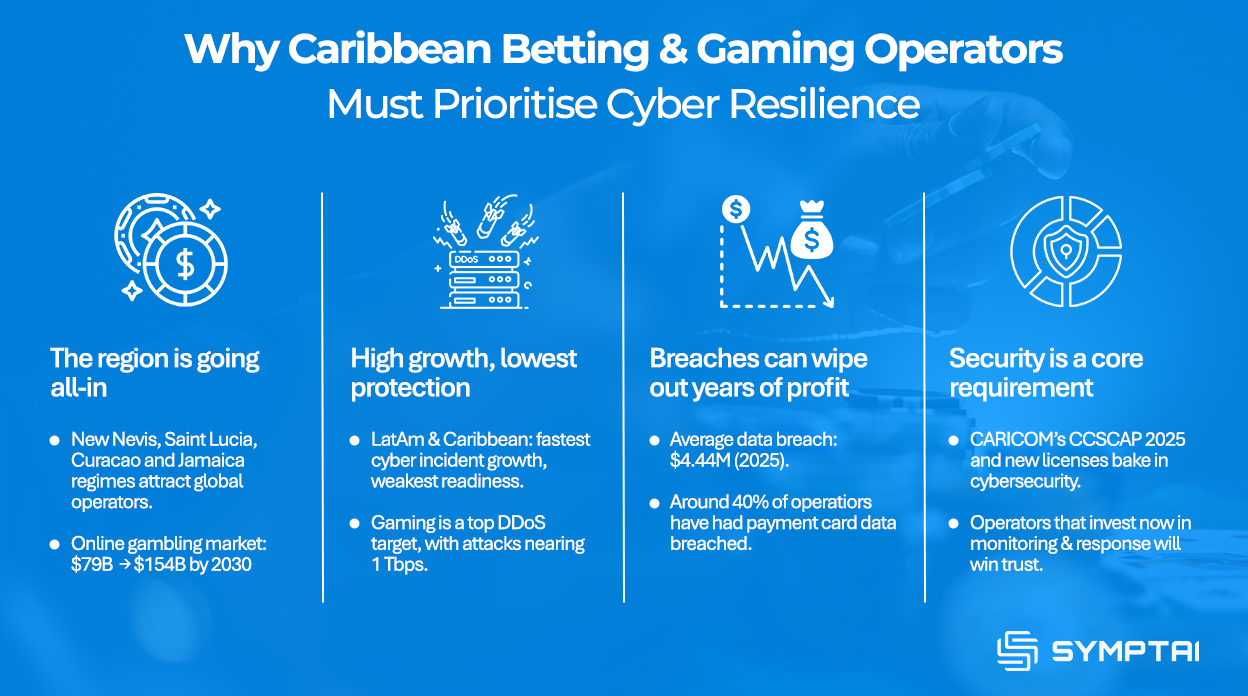 The Caribbean is making its boldest play yet in the global gambling arena. In late April 2025, Nevis passed the Nevis Online Gaming Bill, 2025, and the Online Gaming Ordinance took effect on 1 May 2025, establishing the legal basis for licensing and regulation (Fast Offshore, 2025). Similarly, Jamaica established the AML/CFT/CPF Risk-based Supervisory Framework was in September 2024, while Curaçao has rolled out major reforms to its gaming licensing regime, raising compliance expectations and resetting operator standards across the jurisdiction. (Yogonet, 2025).
These moves position Caribbean nations at the heart of a global online gambling market valued at $79 billion in 2024 and projected to reach $154 billion by 2030 (Grand View Research, 2025). But this digital gold rush comes with a shadow few operators are adequately addressing: the region has become a prime target for cybercriminals.
The Bullseye on Paradise
The numbers are alarming. Latin America and the Caribbean now lead the world in disclosed cyber incident growth, with a 25% average annual increase over the past decade (European External Action Service [EEAS], 2025). More troubling still, the region scores just 10.2 out of 20 on global cybersecurity indices, making it the least protected digital economy on earth (EEAS, 2025).
The threat isn’t theoretical. Jamaica recorded 4 million attempted cyberattacks in the first half of 2024 alone (Connell, 2025). Trinidad & Tobago reported 91 official incidents in 2025—a 22.9% decrease from 2024 (118 incidents), but still a 75% increase over 2023 (52 incidents). Meanwhile, in late July 2025, a major ransomware attack hit Curaçao’s Tax and Customs Administration, underscoring that Caribbean institutions remain vulnerable.
For gaming operators specifically, the picture is even more concerning. Gaming was the most targeted industry for Layer 7 (HTTP) DDoS attacks in 2024, with incidents surging 94% year over year (Help Net Security, 2025). In Jamaica, across the gaming operators we assessed in 2025 through internal, external, web, and mobile testing, 16.67% of findings were Critical, 20.83% were High, 41.67% were Medium, and 20.83% were Low meaning 37.5% of all issues fell into Critical/High severity and required urgent remediation. Against that backdrop, it is no surprise that attackers are also timing disruption for maximum impact: a ~1 Tbps-class DDoS attack hit an online betting organisation in 2025, timed to coincide with a major NHL sporting event when transaction volumes peaked (TechRadar, 2025).
When the House Loses
The consequences of inadequate cyber resilience extend far beyond operational disruption. In November 2025, International Game Technology, a multi-billion-dollar global gambling technology leader, was claimed by the Qilin ransomware group (Cybernews, 2025). Bragg Gaming disclosed a breach in August (Fletcher, 2025). In July 2025, Flutter Entertainment said a data incident affecting Paddy Power and Betfair exposed customer information (e.g., usernames, emails, and partial address data) and launched an internal investigation; reports suggest up to ~800,000 customers in the UK/Ireland may have been impacted (Edwards, 2025).
The financial stakes are staggering. The global average cost of a data breach now stands at $4.44 million (IBM, 2025). MGM Resorts' 2023 attack resulted in approximately $100 million in losses according to SEC filings. Research indicates that 40% of online gambling operators have experienced payment card data breaches at some point, and GDPR non-compliance can trigger fines up to €20 million or 4% of global turnover (Yogonet, 2024).
Building Resilience Before It's Too Late
The Caribbean is responding. On October 31, 2025, CARICOM launched its updated Cyber Security and Cybercrime Action Plan (CCSCAP) 2025 in Port-of-Spain, introducing a critical sixth pillar focused specifically on incident response (Caribbean Community [CARICOM], 2025). The plan addresses "sophisticated ransomware attacks and identity fraud targeting state apparatus" and establishes frameworks for regional threat intelligence sharing (CARICOM, 2025).
But regulatory frameworks alone won't protect operators. The new Caribbean licensing regimes, Nevis, Saint Lucia, Jamaica, and Curaçao's reformed system, are embedding cybersecurity as core compliance requirements. Operators who build resilience now will gain competitive advantage while those who delay risk catastrophic exposure.
The imperative is clear: implement AI-driven threat monitoring, deploy blockchain-based transparency systems, establish robust incident response protocols, and treat cybersecurity investment as essential infrastructure rather than discretionary spend (Connell, 2025).
The Caribbean has placed its bet on becoming a global iGaming hub. The question now is whether operators will match that ambition with the cyber resilience required to protect it. In a region where cyber threats grow 25% annually, and where the European Gaming and Betting Association documented a 96% spike in attacks on gambling sites during the Euro 2020 championships (EGBA, 2022), waiting is no longer an option.
The house must secure itself, before the next attack proves the odds were never in its favour.
Get a Free Dark Web Scan + Cyber Resilience Check to uncover exposed credentials, brand impersonation risks, and the most urgent gaps in detection and response readiness.
FAQs
Q1. Why is cyber resilience critical for Caribbean betting and gaming operators?
The Caribbean is positioning itself as a global iGaming hub while also sitting in one of the world’s fastest growing but least protected cyber regions, making gaming platforms prime targets for attacks.
Q2. What is the business impact of a major cyberattack on a gaming operator?
A serious breach can cost millions in direct losses, fines and recovery—high-profile cases show impacts near or above $100 million—and can damage brand trust and disrupt operations at peak revenue moments.
Q3. How are regulations changing for Caribbean iGaming operators?
New licensing regimes and regional cyber action plans increasingly bake cybersecurity and incident response into core compliance, meaning operators must prove real resilience, not just maintain paper-based policies.


-(7).png)


